

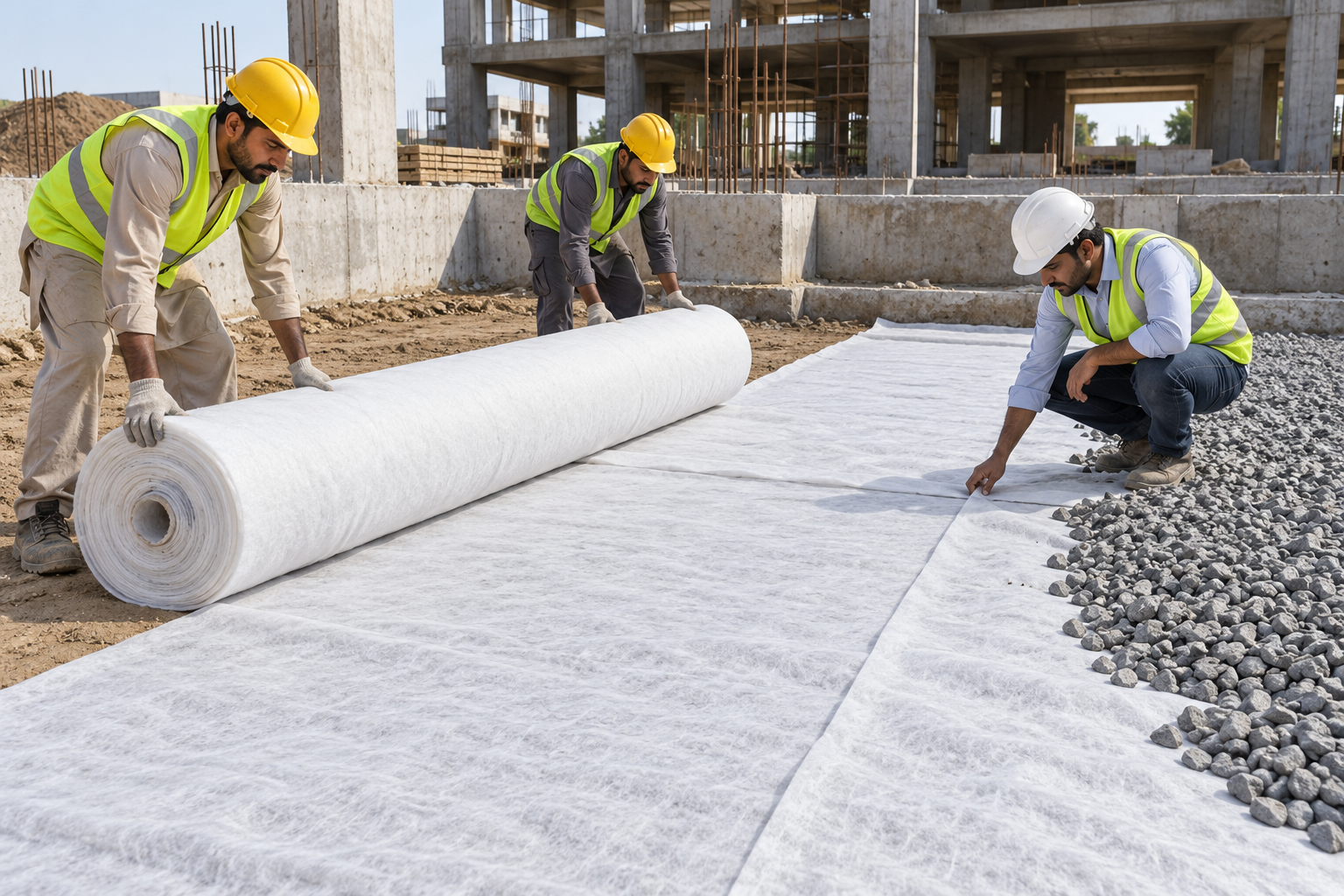
GeoTech Lining PVT LTD offers geotextile solutions for projects requiring soil separation, filtration, drainage, reinforcement, and protection. Nonwoven geotextiles are commonly selected for filtration, cushioning, and drainage applications, while woven geotextiles are frequently used where separation and tensile reinforcement are required.
Geotextiles can be applied in road construction, highways, railway tracks, drainage trenches, retaining walls, embankments, erosion control, landfill systems, and geomembrane protection.
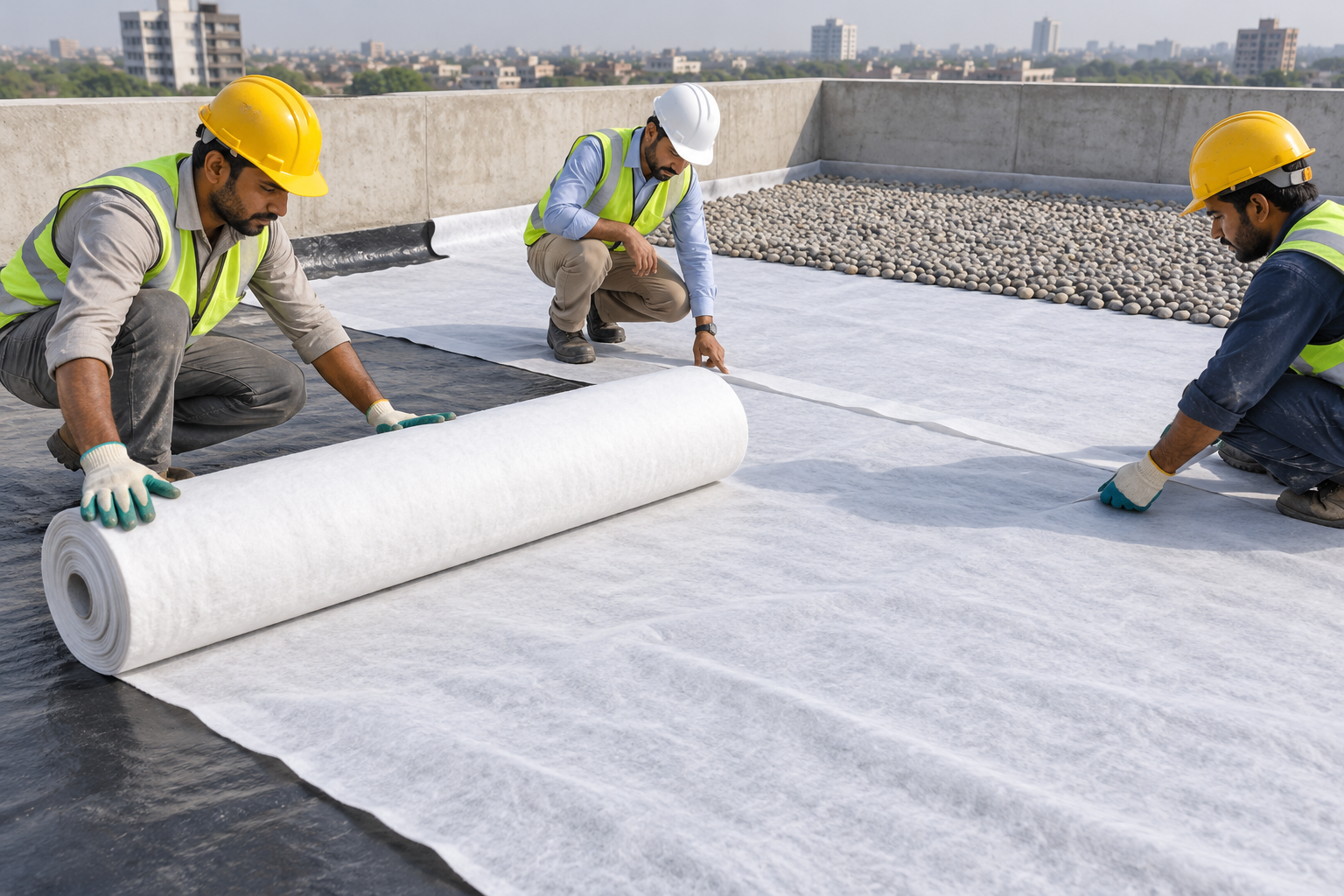
Geotextile protection layers are used with geomembranes in reservoirs, canals, landfills, wastewater treatment facilities, and other containment projects. The fabric provides cushioning between the geomembrane and adjacent surfaces, helping reduce the risk of puncture and mechanical damage.
Nonwoven geotextiles are commonly selected for cushioning because their thickness and fibre structure can help distribute localized stresses. The required GSM and mechanical properties depend on the geomembrane type, subgrade condition, overlying material, and project loading.
GeoTech Lining PVT LTD’s geotextile delivers separation, filtration, drainage, reinforcement, and stress absorption in one fabric. It suits roads, canals, dams, embankments, and landfills across Pakistan. We supply grades from 120 GSM to 500 GSM to match every project’s load and drainage needs. This range ensures long-term soil stability, erosion control, and dependable performance.
These Geotextile can be applied on the followings: Runways & Airports, Canals & Dams, Coastal Protection
| GSM (g/m²) | Thickness (Approx.) | Application / Usage | Available Width | Material Type |
|---|---|---|---|---|
| 120 | ~0.8 mm | Separation and filtration for light landscaping | Up to 4.2 m | PET Polyester |
| 150 | ~1.0 mm | Subgrade stabilization, pathways and drainage | Up to 4.2 m | PET Polyester |
| 200 | ~1.2 mm | Road construction and canal lining protection | Up to 4.2 m | PET Polyester |
| 250 | ~1.5 mm | Dam and pond lining protection layer | Up to 4.2 m | PET Polyester |
| 300 | ~1.8 mm | Heavy drainage and embankment protection | Up to 4.2 m | PET Polyester |
| 350 | ~2.0 mm | Filtration under riprap and retaining walls | Up to 4.2 m | PET Polyester |
| 400 | ~2.2 mm | High-load areas and erosion control | Up to 4.2 m | PET Polyester |
| 500 | ~2.5 mm | Dams, landfills and high-strength applications | Up to 4.2 m | PET Polyester |
Note: Thickness, available widths, material composition, and other specifications may vary by product. Confirm the exact values against the selected product's technical data sheet.
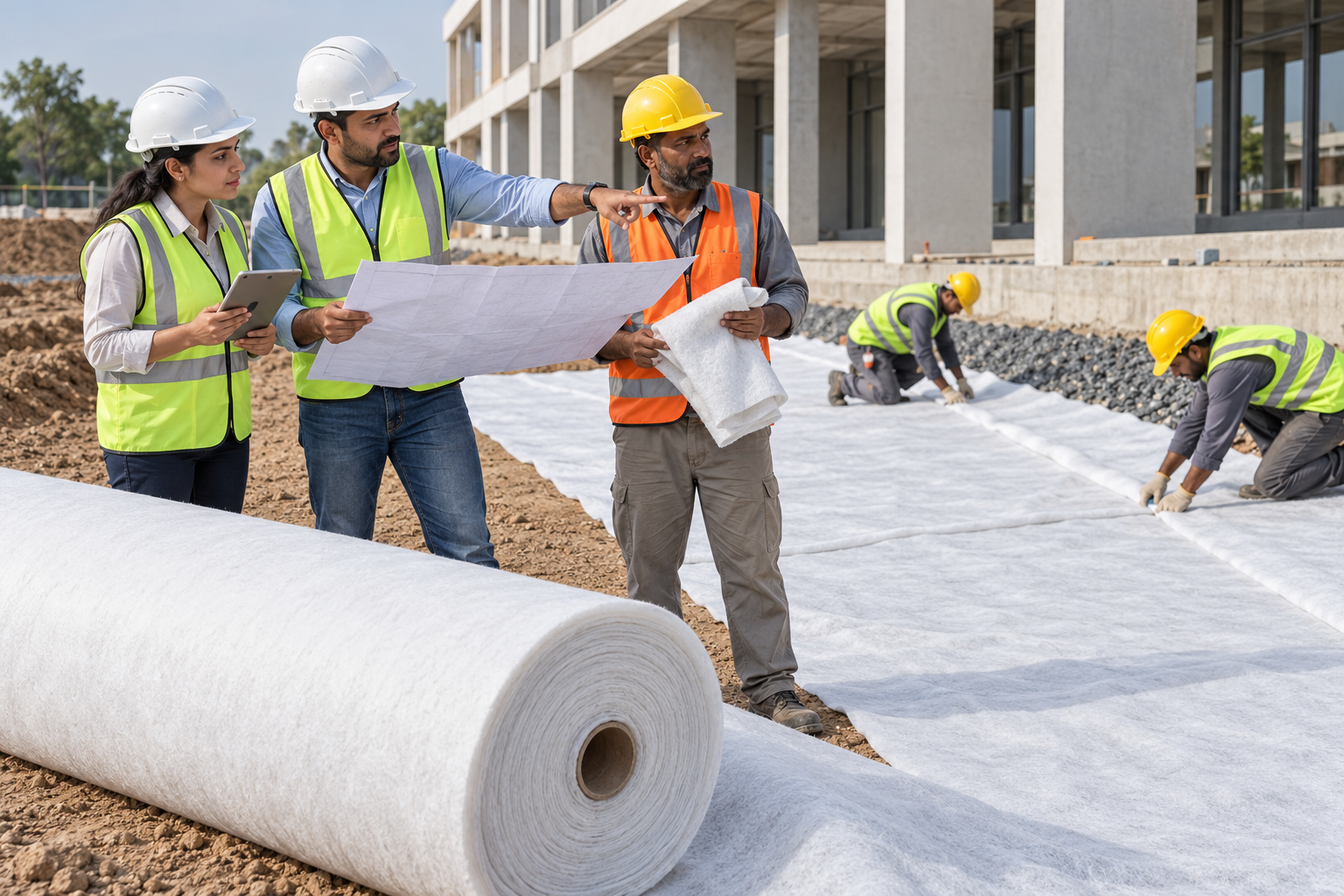
We provide geotextile solutions for projects of different scales, helping clients identify suitable fabrics for soil stabilization, drainage, filtration, and protection. From site assessment to material selection and installation guidance, we focus on matching the product to the project’s engineering requirements.
Our team reviews soil conditions, subgrade strength, groundwater movement, loading requirements, and site exposure. This assessment helps determine the geotextile function and the performance properties required for the application.
We help clients select the appropriate woven or nonwoven geotextile according to the intended function, GSM, tensile strength, permeability, puncture resistance, and soil characteristics. This ensures that the selected material is suitable for the design requirements.
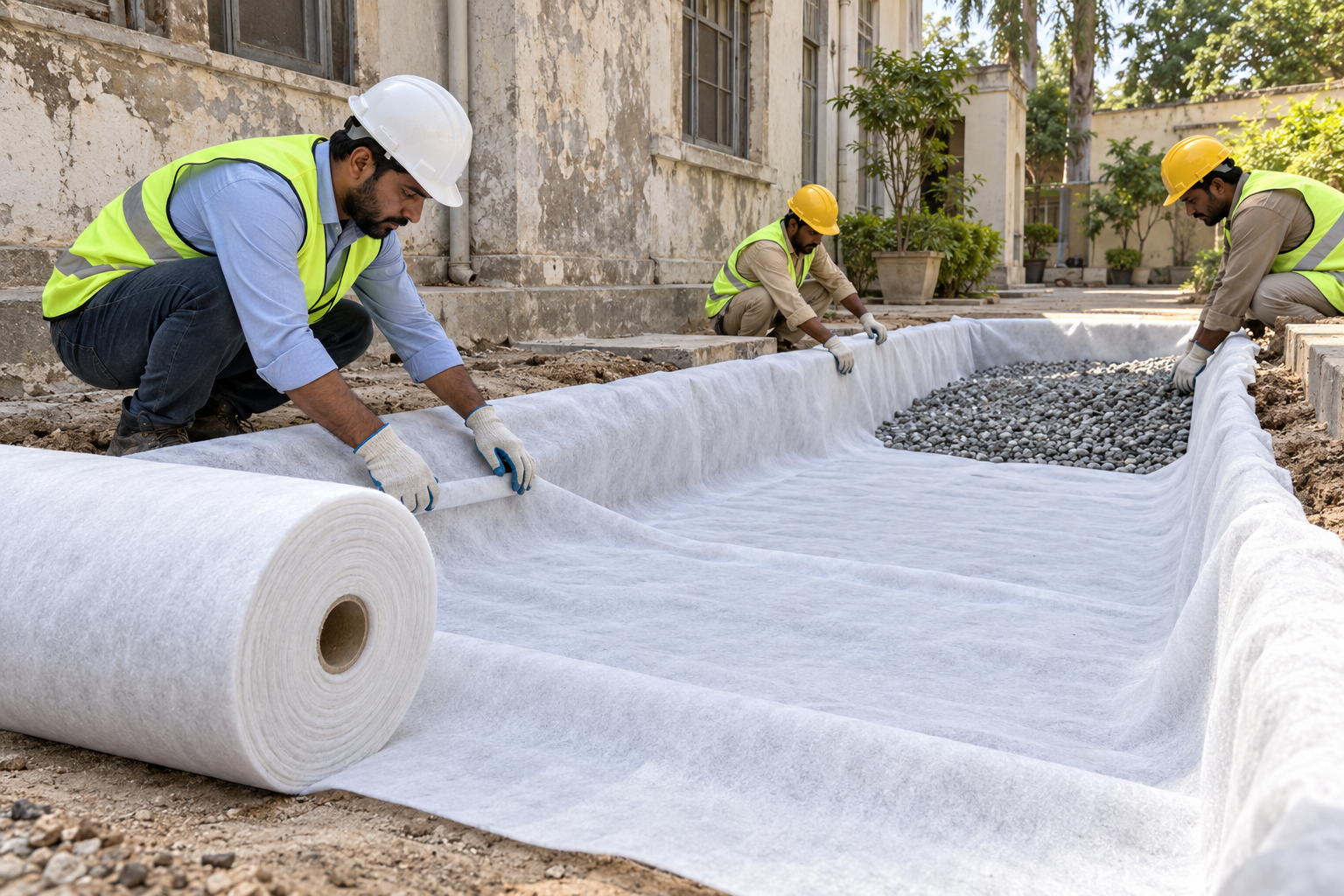
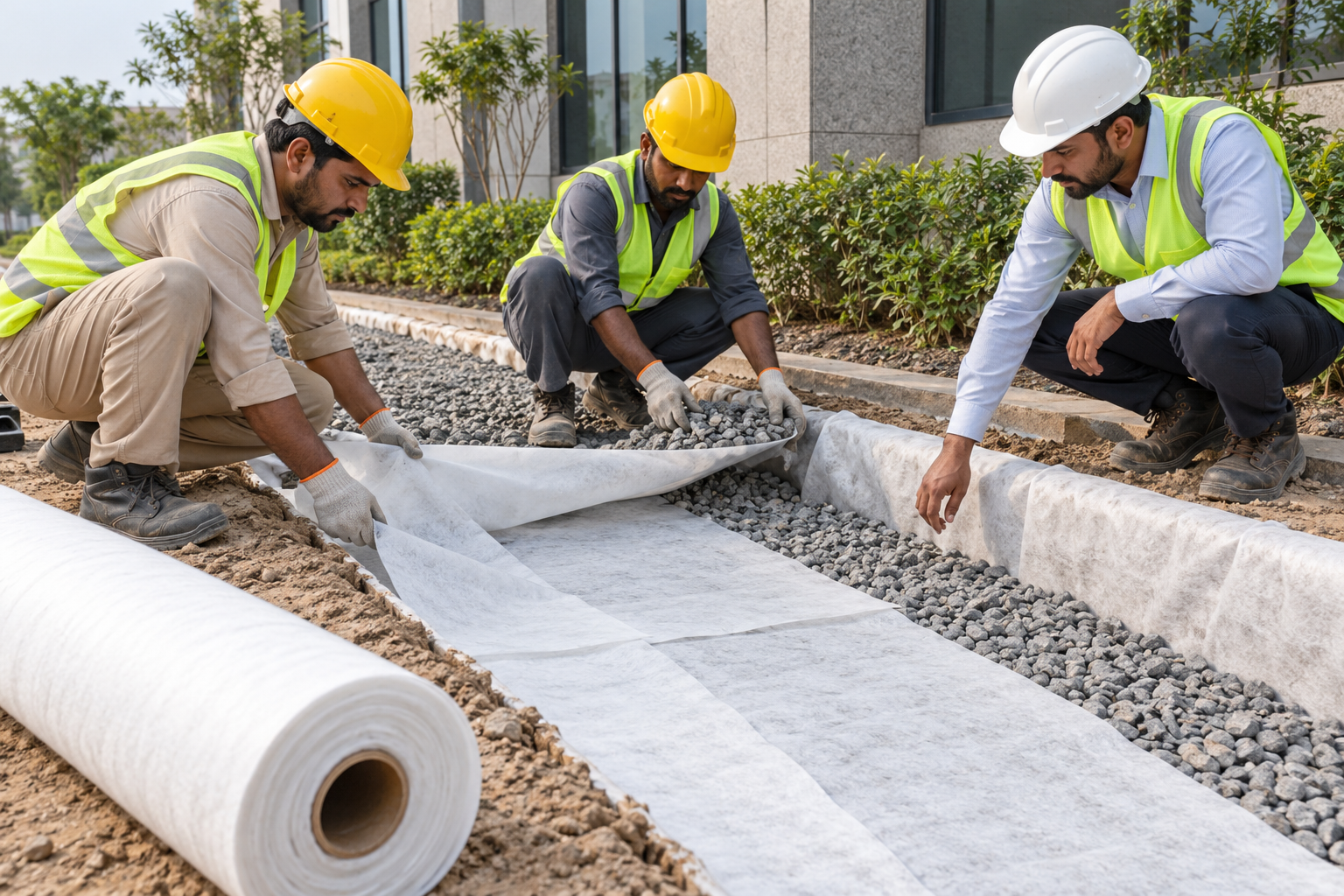
Correct installation helps geotextiles perform as intended. The fabric is placed over a suitably prepared surface, with appropriate overlaps, anchoring, and protection against damage from construction equipment or sharp aggregate installation.
Nonwoven geotextile is manufactured by bonding synthetic fibres through mechanical, thermal, or other suitable processes. Its porous structure makes it suitable for filtration, drainage, separation, and cushioning applications.
Water can pass through the fabric while soil particles are retained according to the selected material’s filtration characteristics. Nonwoven geotextiles are frequently used behind retaining walls, beneath drainage aggregates, under geomembranes, and in road and landscaping projects.
The fabric’s thickness, permeability, puncture resistance, and tensile properties should be selected according to site conditions and project specifications.
Woven geotextile is produced by interlacing synthetic yarns or tapes to form a structured fabric. It is commonly used for soil separation and reinforcement where tensile strength and dimensional stability are important.
Woven geotextiles are suitable for selected road construction projects, access roads, embankments, working platforms, and applications involving weak subgrades. Their performance depends on tensile properties, elongation, opening size, and compatibility with the surrounding soil.
The appropriate product should be selected based on the design loads, soil conditions, and required separation or reinforcement function.
Geotextiles play an important role in drainage systems by allowing water to pass through the fabric while limiting the movement of soil particles. They are commonly installed around drainage aggregates, perforated pipes, retaining walls, and subsurface drainage systems.
Correct fabric selection helps reduce soil migration into drainage materials and supports the long-term functionality of the drainage system. Permeability, apparent opening size, soil gradation, and clogging resistance should be evaluated to ensure compatibility with the site conditions.
In road stabilization applications, geotextile is placed between the prepared subgrade and the aggregate base course. This layer helps prevent the two materials from mixing under construction traffic and repeated loading.
Maintaining separation can reduce aggregate contamination and help preserve the stability of the base course. The actual improvement depends on the soil type, drainage conditions, installation quality, and the mechanical properties of the selected fabric.
Geotextiles are widely used in civil engineering, infrastructure, transportation, drainage, environmental protection, and landscaping. They improve the performance of engineered soil systems by performing one or more functions according to their design.
Common applications include:
Road and Highway Construction: Separating subgrade soil from aggregate layers and supporting pavement performance.
Road Stabilization: Helping maintain the integrity of aggregate layers over weak or variable soils.
Railway Construction: Supporting separation and filtration in suitable track-bed systems.
Drainage Systems: Filtering soil around drainage pipes, trenches, and aggregate layers.
Retaining Walls: Allowing water to pass while helping prevent soil migration into drainage materials.
Canals and Reservoirs: Protecting geomembranes and supporting filtration in selected lining systems.
Landfills: Providing cushioning and protection for containment membranes as part of engineered lining systems.
Erosion Control: Supporting soil retention and stabilization in suitable slopes and embankments.
Landscaping: Separating soil and aggregate layers in pathways, paved areas, and garden projects.
Coastal and Hydraulic Engineering: Supporting filtration and soil retention in selected shoreline and water-management structures.
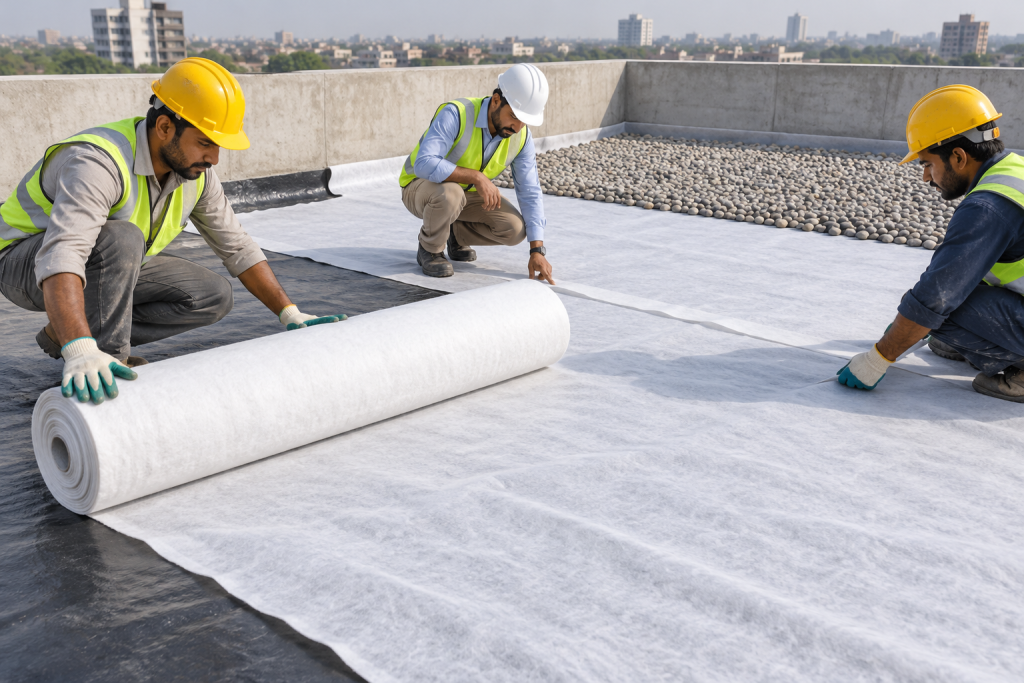
Geotextiles are used in road and runway construction to help maintain the separation between natural subgrade soil and aggregate base layers. This separation reduces the migration of fine soil into the aggregate and helps preserve the designed thickness and performance of the pavement structure.
Depending on the application, geotextiles can also provide filtration, support drainage, and contribute to improved performance over weak subgrades. Selection should consider soil conditions, traffic loading, aggregate characteristics, and the pavement design.
Geotextiles can be used in selected pavement rehabilitation projects as interlayers between existing pavement surfaces and new asphalt overlays. We at GeoTech PVT LTD cares on the product and installation method being used, these systems may help manage moisture or reduce the propagation of certain pavement cracks.
Specialized paving fabrics are typically selected for asphalt interlayer applications. Their suitability depends on asphalt compatibility, binder application, pavement condition, and the rehabilitation design.

GeoTech Lining PVT LTD has successfully installed a diverse range of Geo-synthetic applications, ranging from small farm dams to canal lining and complex floating.